
On February 1, 2024, the Durando campus of the Politecnico di Milano hosted the conference presenting the research findings of the Artificial Intelligence Observatory.

Once again this year, artea.com was pleased to be among the official sponsors and to participate as a speaker at the event: our CTO and Co-founder, Florindo Palladino, delivered a speech titled “Beyond Data Chaos: Transforming Information Overload into Opportunities with Prompt Engineering.”

THE DIGITAL INNOVATION OBSERVATORIES OF THE MILAN POLYTECHNIC

Artificial Intelligence Observatory: What It Is and What It Does

The Artificial Intelligence Observatory was founded in 2017 to address a specific need: to meet the growing demand from public and private companies for new technologies that enableArtificial Intelligence (AI). The goal is to build a community and establish a forum for discussion—and thus for networking—to explore the real opportunities offered by AI, combining managerial perspectives and technological expertise, thanks to the contributions of the Department of Management Engineering and the Department of Electronics, Information, and Bioengineering at the Politecnico di Milano.

The Observatory is dedicated to the study, research, and analysis of trends, applications, and the potential of Artificial Intelligence, and in particular aims to:

  • Identify the main trends and investment strategies of Italian companies in AI technologies.
  • to analyze the level of advancement of large Italian companies and SMEs with regard to AI.
  • to examine AI projects developed by Italian companies.
  • Identify the dominant technological trends in the field of AI, including techniques such as machine learning, deep learning, robotic process automation, natural language processing (NLP), and generative AI.
  • explore the fundamental techniques for developing AI-based application solutions.
  • to examine consumer perceptions of AI-enhanced products and services.
  • discuss the ethical issues raised by the use of AI.
THE RESULTS OF THE OBSERVATORY'S RESEARCH

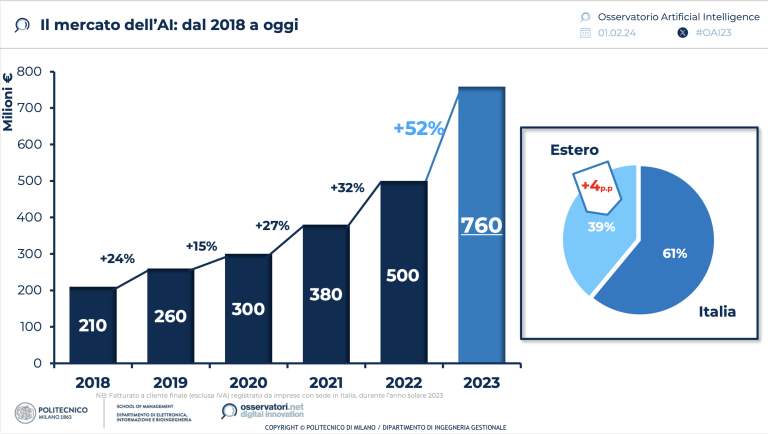
AI growth in the Italian market up 52%

According to research findings from the Artificial Intelligence Observatory at the School of Management of the Politecnico di Milano, the artificial intelligence sector in Italy is experiencing significant growth, with the market expanding by 52% in 2023 to reach 760 million euros. This growth follows the 32% increase seen in 2022. Most investments are focused on text analysis and interpretation, classification, and conversational systems, while Generative AI currently accounts for 5% of investments.

AI is a topic now familiar to nearly all Italians (98%), and as many as 29% have a medium-to-high level of knowledge on the subject. Despite this widespread interest, however, a certain degree of concern persists in Italy, particularly regarding the potential impact on employment. In fact , it is projected that automation could replace 3.8 million jobs in Italy over the next ten years.

From a business perspective, the data shows that 90% of the AI market is dominated by large enterprises, with the remainder split between SMEs and the public sector. The Telco-Media and Insurance sectors lead in average AI spending. In terms of adoption, however, while 61% of large companies have launched AI projects, SMEs lag behind with a share of only 18%.

An analysis of companies’ maturity in the field of AI further reveals that 11% are at the forefront, while 23% are in the learning phase. Despite market growth and the proliferation of projects, a sense of caution persists, particularly regarding the implications for the workforce. Demographic projections suggest that automation could help bridge an employment gap in the future, but it is clear that it will be essential to pay attention to workers’ training needs and to ensure the equitable distribution of the benefits derived from this new technology.

Florindo Palladino's Speech

AI in the Spotlight: News, Applications, and Regulations

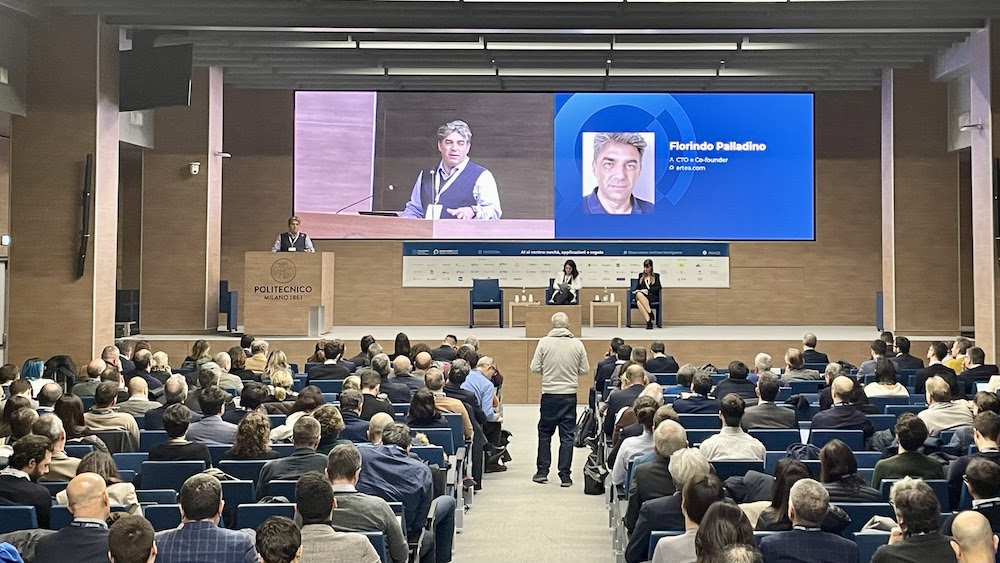
Florindo Palladino, CTO and Co-Founder of artea.com, spoke at the conference “AI at the Center: Innovations, Applications, and Regulations.”

In his speech “Beyond Data Chaos: Turning Information Overload into Opportunities with Prompt Engineering,” Florindo summarized the challenges posed by data management in companies, suggesting practical strategies for implementing Prompt Engineering on business documents, complete with case studies and real-world applications.
AI in the Spotlight: News, Applications, and Regulations

Our CTO noted how the useof generative AI has become widespread over the past year, thanks to the use of natural language in conversational systems. With this technology, the field of Prompt Engineering, which Florindo defines as “the art of formulating instructions—known as prompts—designed to maximize the effectiveness and accuracy of the responses we receive from AI.”

Finally, Florindo highlighted the ethical implications and privacy considerations related to the use of AI in document management, emphasizing the importance of balancing innovation and responsibility. By providing an overview of the future prospects of prompt engineering and AI in corporate data management, he offered insights into how organizations can continue to evolve and adapt in a digital landscape that is undergoing constant and rapid transformation.