Deep learning is a branch of machine learning that uses deep layers of artificial neural networks to analyze data and learn complex patterns from it.
At the intersection of artificial intelligence and machine learning, deep learning represents a frontier in technological research: with it, neural networks not only learn, but do so at levels of complexity and depth that go far beyond what is traditional.
In this article, we aim to define what deep learning is, highlighting how these technologies are redefining what machines can do and providing an overview of their numerous and surprising applications.
The Era of the Perceptron and the Evolution Toward Deep Learning
The Perceptron, one of the first neural network models, introduced by Rosenblatt in the 1950s, broke new ground in the field of AI. However, a significant limitation soon became apparent: the “single-layer” perceptron could not learn or recognize many classes of patterns. This realization significantly slowed down research until the power of a neural network known as a “multilayer” perceptron was explored.
A key component of the multilayer perceptron is the so-called “hidden layer.” While in a single-layer perceptron, the input is directly transformed into an output, in a multilayer network there are one or more internal layers of nodes, hidden between the input and the output. These intermediate layers can capture and model complexities and abstractions that are not immediately visible at the network’s input or output.
Table of contents
- The Era of the Perceptron and the Evolution Toward Deep Learning
- The Power of Hidden Layers and the Deep Learning Revolution
- So what is the difference between machine learning and deep learning?
- The breakthrough in deep learning lies in the numbers
- Billions of Parameters for a Neural Network
- Massive datasets for training
- The World of Deep Learning: An Overview of Applications
- An Architecture for Every Problem: The Superstars of Deep Learning
- The Unpredictable Prospects of Generative AI
- Innovate with artea.com: Turn Your Vision Into Reality
The Power of Hidden Layers and the Deep Learning Revolution
Deep learning takes this concept even further. It is based on neural networks with multiple hidden layers. Each layer tends to specialize in different aspects of the cognitive process, operating at increasingly higher levels of abstraction. In this way, the additional layers enable the network to construct and learn hierarchies of features—from the simplest to the most complex—mirroring the human process of incremental learning.
Thanks to this architecture, deep learning is revolutionizing numerous fields—from computer vision to natural language understanding—and offers unimaginable opportunities.
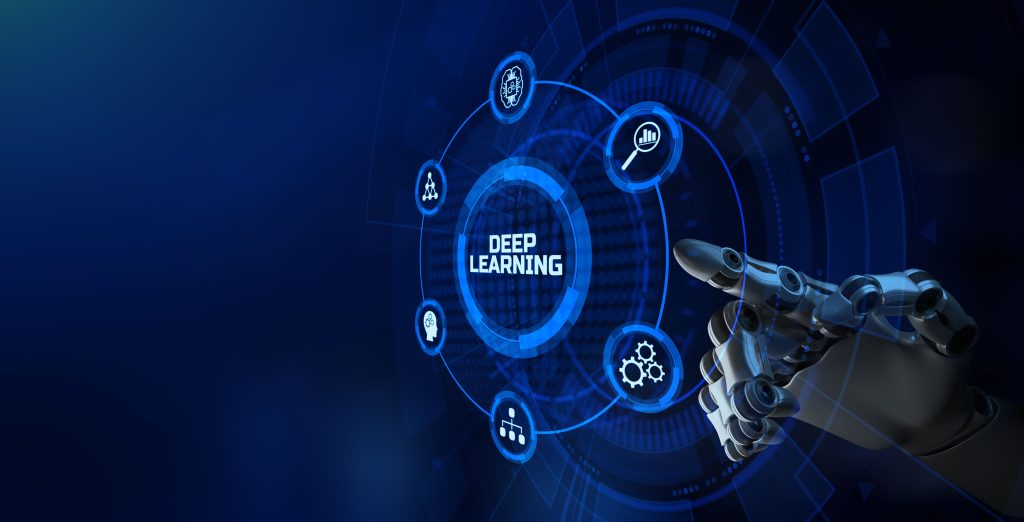
So what is the difference between machine learning and deep learning?
Machine Learning (ML) and Deep Learning (DL) are two closely related concepts in the field of artificial intelligence, but they have significant differences.
Machine Learning (ML) is a broad field that encompasses methods and techniques for teaching machines how to learn from data. It uses algorithms that can learn and make predictions or decisions based on past data, without being explicitly programmed to do so.
Deep Learning (DL) is the branch of Machine Learning that uses neural networks with multiple layers (hence the term “deep”). These layers allow the model to learn automatically and progressively from data through successive levels of abstraction.
The difference between Machine Learning and Deep Learning lies in the fact that ML can use both simple and complex methods, while DL focuses specifically on complex neural networks and much larger datasets, allowing it to capture more subtle and abstract relationships in the data. In summary, DL is a specialization within the broader field of ML, leveraging more elaborate network architectures to tackle more complex challenges.
The breakthrough in deep learning lies in the numbers
Deep learning is a revolution in that it is driven by an exponential increase in both the number of nodes and parameters in neural networks and the size of the datasets required to train them. To understand the magnitude of this leap, let’s consider these two variables:
Billions of Parameters for a Neural Network
Modern deep learning (DL) neural networks, especially in large language models (LLMs), can have an impressive number of training parameters— up to 350 billion in open-source models.
Version 3.5 of ChatGPT has approximately 175 billion parameters, while the upcoming version 4.0 reaches 100,000 billion. Olympus, the new model currently under development by Amazon, promises to multiply this figure by a thousand. These numbers demonstrate exponential growth in terms of complexity and processing power.
Massive datasets for training
The dataset required to train these networks is equally impressive. A token—which can be a syllable or a piece of text—represents the basic unit of input for an LLM model. For example, Meta’s Llama2 was trained on approximately 2 trillion tokens, while the amount of data in Wikipedia is on the order of 4 billion words. This vast amount of data requires unprecedented computational power and raises important questions regarding energy consumption and environmental impact, such as the large associated carbon footprint.
The World of Deep Learning: An Overview of Applications
The DL has already been used in extraordinary ways across various sectors, demonstrating its versatility and power. Here are a few examples:
- Natural Language Processing (NLP): for machine translation, voice assistants, and sentiment analysis; well-known examples include Google Translate and Apple’s Siri.
- Computer Vision: for facial recognition, the interpretation of medical images, and vision systems in autonomous vehicles, such as those used by Tesla.
- Signal Processing: for predictive maintenance in industry, where it helps prevent failures through the early analysis of sensor data.
- Classification and Prediction: for analyzing and grouping data on customer profiles, enabling companies to identify patterns and segment based on various factors.
- Generative AI: for creating music, text, and content; well-known examples include OpenAI’s DALL-E for image generation and GPT for text generation.
- Medical research: for the analysis of diagnostic images, drug development, and research on molecular structures, such as DeepMind’s AlphaFold project for predicting protein structures.
- Pure mathematics: to test and develop new mathematical theories and models; for example, Wolfram ML is a feature built into the Wolfram Alpha computational search engine, known for its ability to solve complex mathematical problems.
- Robotics: to enable robots to learn and adapt to complex tasks, thereby improving their interaction with the environment and humans.
- Games and simulations: to develop artificial intelligence capable of playing and competing at human or higher levels in complex games, such as Go or chess.
An Architecture for Every Problem: The Superstars of Deep Learning
If by “architecture” we mean the internal geometry of a network, we can say that every architecture is unique and optimized for specific applications, demonstrating the flexibility and wide range of potential of deep learning. Let’s look at some of the best-known ones:
- Natural Language Processing (NLP):
BERT (Bidirectional Encoder Representations from Transformers): It introduced the concept of bidirectional attention layers, which enabled the model to analyze the full context of a word in a text from both directions, revolutionizing the way machines understand human language. - Computer Vision:
AlexNet: The first successful convolutional neural network (CNN), which marked a turning point in image analysis by improving visual recognition.
Meta’sDINO V2: one of the first Vision Transformer models, which goes beyond traditional convolution by applying a concept typical of NLP to Computer Vision (the Transformer).
YOLO (You Only Look Once): Innovative for object detection, it optimizes image analysis by enabling the recognition of objects within an image in a single pass, processing the entire image simultaneously rather than in separate parts. - Generative Artificial Intelligence:
T5 (Text-to-Text Transfer Transformer): This model has evolved the BERT approach to handle a variety of natural language processing tasks with a single model.
LLM (Large Language Models): OpenAI’s ChatGPT, Bard, and now Google’s new Gemini, Meta’s Llama2 (open source), X Twitter’s Grok, and Amazon’s Olympus.
OpenAI’sDALL-E: the Stable Diffusion model revolutionizes generative AI by creating realistic images from textual descriptions.
Medical Research DeepMind’s (Google)AlphaFold: It has solved the problem of protein folding, significantly accelerating biomedical research and our understanding of how amino acids fold to form proteins.
Mathematics DeepMind’s (Google)AlphaTensor —a model for optimizing matrix multiplication—has significantly improved the efficiency of mathematical computation techniques.
The Unpredictable Prospects of Generative AI
Generative artificial intelligence is gaining increasing attention for its ability to create content such as text, video, and audio. This branch of deep learning uses specialized architectures to generate new data that is often indistinguishable from real data.
One of the most common approaches is the use of autoregressive models. A classic example is OpenAI’s GPT (Generative Pretrained Transformer). In these models, the output generated in one step is used as input in the next step, creating a self-reinforcing chain of content generation. This process allows the model to produce coherent and contextually relevant text.
GANs (Generative Adversarial Networks) have introduced an innovative methodology in the field of image generation. In a GAN, two neural networks are trained in parallel: one network generates images, while the other attempts to distinguish the generated images from real ones. This “game” between the two networks improves the quality of the generated images, allowing for surprisingly realistic results even from small datasets.
Interestingly, generative AI is not limited to creating content for human use; it can also generate datasets to train other models. For example, the dialogs produced by GPT-3.5 have been used to train open-source LLMs.
Innovate with artea.com: Turn Your Vision Into Reality
In the fast-paced world of deep learning and generative artificial intelligence, staying up to date with the latest innovations is essential. If you’re looking to leverage these advanced technologies to transform your business, artea.com is the right partner for you.
With our expertise in AI, machine learning, and systems integration, we’re ready to guide you in bringing your most ambitious ideas to life. From intelligent automation projects to data analytics, from medical research to content generation, our team of experts is here to support you.
Contact artea.com today to explore how we can help you harness the power of deep learning and take your business into the future.