Quantum computing represents one of the greatest technological leaps of our time. In this article, we introduce the concept of quantum computing, briefly outlining its history and development.
We will examine the fundamental differences between quantum and classical computing, laying the groundwork for a deeper understanding of how a quantum computer works and its many potential applications.
Table of contents
- The Quantum Computer: At the Dawn of a New Technological Era
- Definition and Principles of Quantum Computing
- The Exponential Rise of Microelectronics
- The Invisible Wall and the Leap into the Quantum Realm
- Speed and Precision in the Age of Big Data: Applications of Quantum Computing
- Safer and Smarter Driving
- Truly Personalized Medical Treatments
- More Efficient Molecular Modeling and Logistics
- Taming the Untamable: The Stabilization of Qubits
- The Global Race for Quantum Computing
- A New Era for Cryptography and Security
- Always stay one step ahead with artea.com
The Quantum Computer: At the Dawn of a New Technological Era
Imagine standing in front of a massive mosaic, made up of billions of tiles, and so complex that traditional methods of solving it seem inadequate. This is where the quantum computer comes in: a sort of “cosmic telescope” that promises to decipher the mosaic with unprecedented speed and precision.
But what exactly is a quantum computer, and what principles govern how it works?
Definition and Principles of Quantum Computing
A quantum computer is a data-processing device that operates according to the laws of quantum mechanics. Its fundamental building blocks are called qubits, which can exist in a superposition of states; this allows multiple calculations to be performed in parallel. It’s as if, instead of taking just one path at a time, we could explore all the paths simultaneously.
A qubit, or quantum bit, is therefore the fundamental unit of information in the quantum world, similar to the bit in traditional computers. If a bit can be compared to a coin that is in only one state (either heads or tails), a qubit is like a coin that can be in both the heads and tails states at the same time, as well as in all the intermediate states between these two. This state persists until the qubit is observed, at which point it will assume a definite state (either heads or tails).
This ability to exist in multiple states simultaneously allows quantum computers to perform calculations in new and powerful ways, paving the way for processing speeds and problem-solving methods that far exceed the capabilities of traditional computers.
The Exponential Rise of Microelectronics
Starting in the 1970s, an insight guided the computer industry toward new milestones: Moore’s Law. More than a law of physics, it was a bold prediction that has been borne out for decades: the power of microchips doubles every two years, thanks to the doubling of the number of transistors we can pack onto a single chip. This exponential growth has fueled a digital revolution, making devices smaller, faster, and more efficient.
The Invisible Wall and the Leap into the Quantum Realm
However, all progress has its limits, and Moore’s Law is no exception. We have run up against an invisible wall: the atomic scale.
We cannot continue to reduce the size of transistors indefinitely without running into the limits imposed by the laws of quantum physics. This is where quantum computing comes into play as the designated successor.
Quantum computing is not limited by the physical size of silicon transistors, but operates according to principles that allow it to bypass them, opening up computational possibilities that until now could only be imagined. With qubits, we are no longer confined to a world of 0s and 1s, but can navigate a sea of intermediate states: a universe in which information flows in new and astonishing ways.
Speed and Precision in the Age of Big Data: Applications of Quantum Computing
The ability to process enormous amounts of data in fractions of a second is an advantage we cannot ignore, especially in the age of Big Data. Below are some of the possible applications.
Safer and Smarter Driving
Imagine a car that not only drives itself but is also capable of anticipating and responding to complex situations, such as sudden traffic at a city intersection or an unexpected obstacle on a country road.
Quantum computers could revolutionize the automotive industry by equipping autonomous vehicles with the computing power needed to simultaneously process data from a myriad of sensors, thereby making autonomous driving safer and more reliable.
Truly Personalized Medical Treatments
In the field of medicine, quantum computers promise to usher in an era of personalized treatments.
With the ability to rapidly analyze the human genome, it may be possible to develop personalized treatments that take into account an individual’s unique genetic characteristics. This would open the door to specialized medications for each patient, with side effects minimized and maximum therapeutic efficacy.
More Efficient Molecular Modeling and Logistics
In the pharmaceutical and logistics industries, quantum computers could be the key to unlocking unprecedented efficiencies. The ability to model molecules and chemical interactions with atomic precision could accelerate the discovery of new drugs.
Analyzing vast amounts of data to plan the most efficient routes for products to travel from their point of origin to the end consumer would optimize supply chains globally, ensuring that every product is in the right place at the right time.
Taming the Untamable: The Stabilization of Qubits
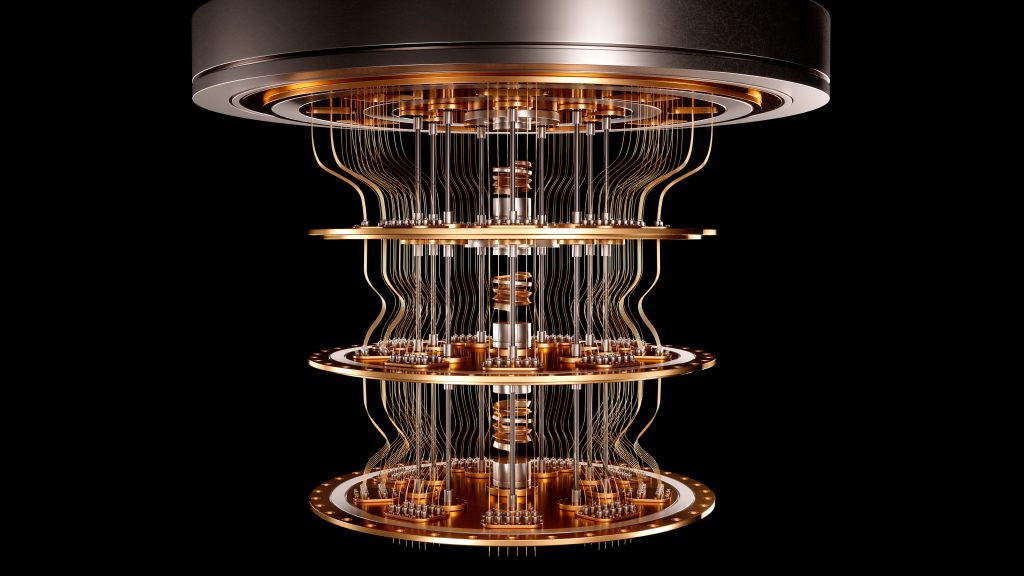
Like any technological frontier, quantum computing must also overcome significant obstacles. At its core lies the challenge of taming qubits—elements that are as promising as they are fickle. In fact, they must operate at temperatures near absolute zero to avoid interference that could cause instability or the loss of encoded information—conditions that, at present, can only be created using complex and expensive systems. Research aims to make qubits more stable and robust, so that they can function even in less extreme environments and make quantum computing a practical and widespread reality.
The second major challenge to be solved is the creation of specific algorithms that can fully harness the unique capabilities of qubits. This involves learning a new programming language that can control quantum bits in an efficient and innovative way. Scientists are working to translate real-world problems into quantum language, a process that requires time and creativity.
The Global Race for Quantum Computing
Quantum computing is not just a matter of scientific progress; it has become a battleground for global supremacy. Leading countries and companies around the world are investing considerable resources to gain an edge in this field. This race is not only about developing new technologies but also about tapping into enormous economic and strategic potential.
In addition to the most technologically advanced nations (the United States, China, and Japan), the European Union is also stepping up its efforts. With a projected investment of one billion euros over the next ten years, this commitment goes beyond funding research projects, aiming to develop a skilled workforce and infrastructure capable of supporting innovation and the application of this technology.
A New Era for Cryptography and Security
With its ability to perform calculations at a speed and complexity unimaginable for traditional computers, quantum computing poses a serious threat to currently used cryptographic techniques. Methods such as public-key cryptography, which rely on the difficulty of factoring large prime numbers, could be easily overcome by a quantum computer. This means that many of the security measures we currently consider unbreakable could be breached with relative ease in the not-too-distant future.
Faced with this vulnerability, the scientific and technological community is exploring new forms of encryption that can withstand even the powerful computational capabilities of quantum computers. Quantum cryptography is based on principles of quantum mechanics that make communication inherently secure. One of the most remarkable features of these systems is that any attempt to intercept or measure the data alters the quantum state of the information, thereby revealing the presence of the intruder. In other words, quantum cryptography not only protects data but also alerts users if someone is attempting to breach it, offering an unprecedented level of security.
Always stay one step ahead with artea.com
We live in an era characterized by a constant and incredibly rapid flow of technological advances, to the point where innovation is no longer an option but a necessity. Although it may seem today to be a realm of possibilities and intuitions rather than concrete, short-term certainties, the implications of quantum computing are too significant to be ignored.
In this landscape, it is essential to collaborate with a partner that not only understands emerging trends but is also actively involved in shaping the future: artea.com stands out as an innovative leader thanks to its dedicated research and development division.
However, our expertise goes beyond experimentation. By working closely with the innovation teams of large companies, we help turn technological breakthroughs into measurable competitive advantages. If you want to stay ahead of the curve and take advantage of the opportunities that emerging technologies have to offer, artea.com is your ideal partner. Visit our website and discover how we can help you navigate the future of innovation.